Contact Us
Adjustable Frame Wholesale: Your Ultimate Guide to Sourcing Versatile Arch Support
One size never fits events. Every job is different, every venue has its quirks, and clients have stopped accepting “we don’t have that size.” If you’re running an event business, your structural inventory either makes you money every weekend or quietly kills your margins. Sourcing the right adjustable frame wholesale isn’t just a procurement decision — it shapes what jobs you can take, how fast your crew can set up, and whether customers come back.
I’ve been a party design consultant and wholesale sourcing specialist for over eight years, working directly with more than 500 event businesses across the US, UK, and Australia. The global event decoration market was valued at $65.8 billion in 2023 and is projected to grow at a 7.2% CAGR through 2030. Arches and structural frames are among the fastest-growing segments. Clients who get their structural inventory right consistently see profit margins climb by around 22% year over year.
The line I keep hearing from new buyers: “An arch frame is just a metal shape — find the cheapest one.” That reasoning leads to bent frames, failed lockups, and a wedding planner who never calls again. A professional-grade adjustable frame is a piece of engineered equipment. Its build quality determines setup speed, load safety, decoration flexibility, and your business’s reputation. Cheap sourcing isn’t saving money; it’s deferring costs with interest.
The Core Buyer Problem: Fixed Inventory Against Constantly Changing Client Requests
Here’s what most sourcing guides skip over: your inventory is either your biggest liability or your best asset. The real problem isn’t finding an arch — it’s finding a system that handles what clients actually ask for. Couples want a custom width for a garden ceremony. Corporate clients want something tall enough to anchor a 300-person gala entrance. Social media-focused events need shapes nobody made a decade ago. Owning a separate fixed-size frame for every possible configuration isn’t financially realistic, and it burns storage space you probably don’t have.
I worked with a rental company in Austin, Texas, that owned twelve fixed-size metal arches. Good quality, zero flexibility. They were turning down jobs because a venue doorway was two feet wider than their largest frame, or because a client wanted a hexagon for a themed installation. By their estimate, they were leaving $45,000 a year in potential revenue uncollected. The warehouse was packed. The service menu was not.
A boutique event stylist in Melbourne spent $2,800 on a single high-quality adjustable frame system with multiple connector types. In her first year, that one system covered 38 events — from 6-foot sweetheart table backdrops to 20-foot ceremony arches — jobs that would have previously needed 15 separate fixed frames. Her return on investment came in four months.
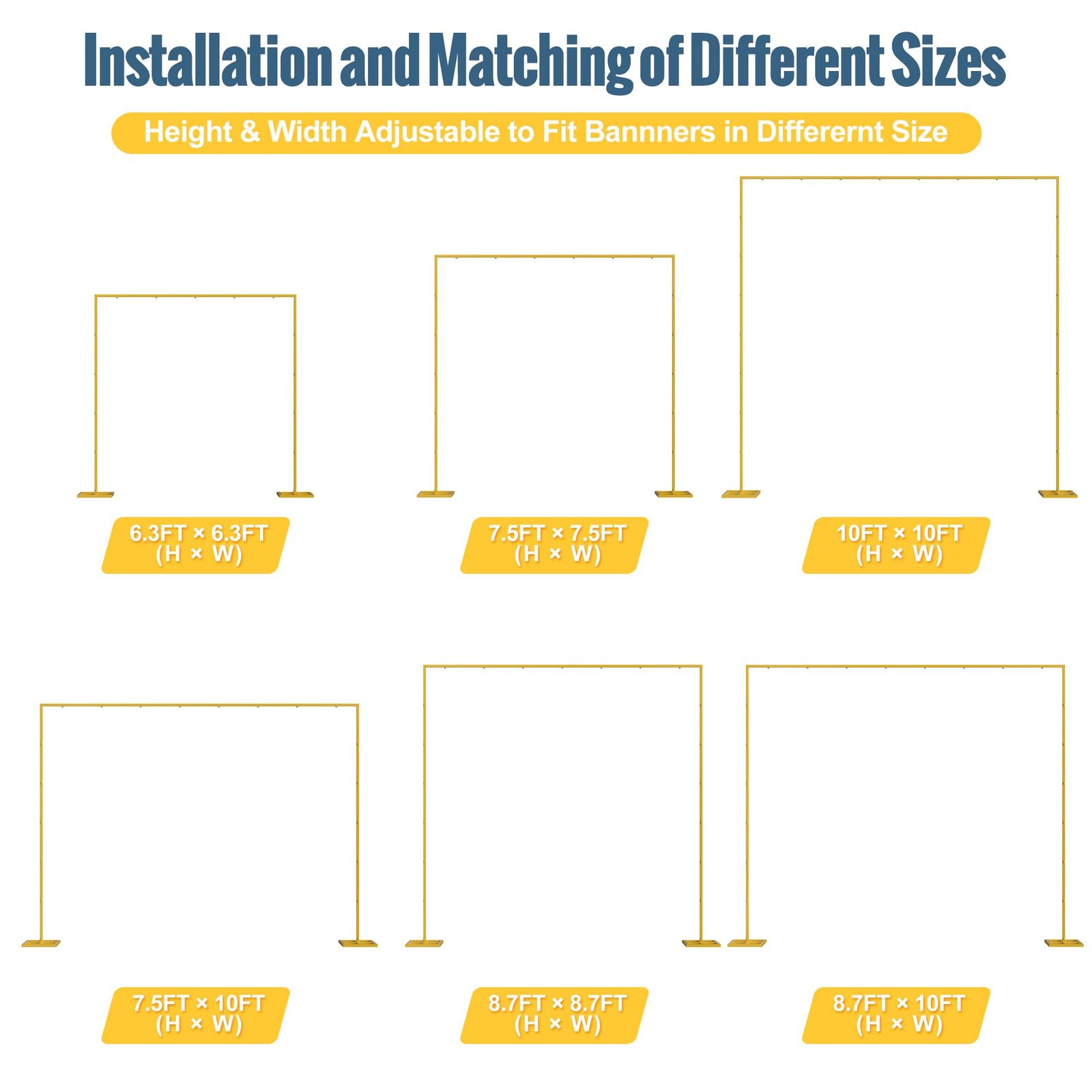
The solution is a modular wholesale supplier. You need frames that adjust in width, height, and shape — classic arcs, geometric hexagons, square backdrops, tunnel structures. One SKU that becomes a dozen usable products depending on how you configure it.
What to Look For in an Adjustable Frame Wholesale Supplier: 5 Things That Actually Matter
Shopping by price per unit is how buyers get burned. Your evaluation has to start with total cost of ownership and operational durability.
Engineering and Material
Aerospace-grade 6061 or 6063 aluminum is the baseline. A lot of suppliers use inferior recycled alloys that feel fine in a showroom and fatigue under real-world wind or heavy floral installations. Tubing wall thickness matters: 1.5mm minimum for standard use, 2.0mm or above for heavy commercial work. The locking mechanism — pin-based, clamp-based, or threaded — has to be industrial grade. A lock that fails mid-setup is both a safety issue and a business reputation problem.
Modularity and Component Range
A real versatile arch support supplier sells a construction system, not just an adjustable arch. Can the base connectors pair with straight poles to build a backdrop grid? Can you add joint pieces to reshape it into a hexagon, square, or canopy? The number of compatible components in their catalog is essentially the length of your service menu.
Load Capacity and Safety Factor
Get the certified static and dynamic load ratings in writing. A frame might hold 50 lbs when it’s sitting still, but that’s not how events work. Linens catch wind, decorators lean on things, and guests occasionally grab supports for balance. Professional frames should carry a safety factor of at least 3:1. If the stated max decorative load is 30 kg, the structure should be engineered to hold 90 kg before it fails. This is not a place to negotiate.
Finish and Coating
Frames get handled, stacked, transported, and used outdoors. Powder coating is standard, but the application quality varies enormously. Poor finishes chip, rust, and make your equipment look worn within a season. For high-end clients, anodized aluminum holds up better and looks more professional.
Technical Support and Documentation
Can the supplier provide assembly manuals, load charts, and CAD diagrams you can use in client proposals? Do they have a technical team available when you’re dealing with a complex installation you haven’t done before? A factory that invests in your knowledge is a business partner. One that ships a box and stops communicating is a commodity vendor.
A buyer in London sourced 50 “bargain” frames at $75/unit instead of the $110 frames I recommended. Eight months later: 30% had seized mechanisms, 20% had chipped coatings with rust, and several locking pins had sheared. Total damage exceeded £12,000. The math: a $110 frame used 100 times costs $1.10 per use. A $75 frame that fails at 5 uses costs $15 per use — plus the hidden costs of the contracts it kills.
Head-to-Head: Adjustable Frame Wholesale Supplier Comparison
The table below is based on actual RFQs, client case studies, and physical teardowns of products from each supplier type.
| Criteria | Generic E-Commerce | Standard Wholesale | Specialized OEM (VastParty) | Premium EU/US Brand |
| Avg. Unit Price (10ft) | $50–$90 | $90–$150 | $110–$180 | $300–$600+ |
| Material & Build | Variable; thin-wall aluminum, weak welds | Decent 6063 aluminum, consistent but basic | High-grade 6061-T6; precision machining, reinforced joints | Top-tier alloys; exceptional build quality |
| Adjustability | Limited (2–3 settings); prone to slipping | Good basic width/height adjustment | Full modularity: width, height, shape kits | Excellent; proprietary quick-lock systems |
| Safety & Load Rating | Rarely certified; high risk | Moderate; 15–25 kg, ~2:1 safety factor | Certified 30–50 kg+, 3:1 safety factor | Very high; engineered for heavy commercial use |
| MOQ & Logistics | Low MOQ, high shipping, 30–60 day lead time | MOQ 50–100; 14–28 days | Flexible from 25 units; FOB Yiwu; 15–21 day production | High MOQ; very high cost |
| Best For | Beginners, minimal capital | Stable demand for standard arches | Growing rental cos., wholesalers needing scalable system | Ultra-high-end where budget is not a constraint |
Sourcing Strategy by Buyer Type
For Event Rental Companies
Durability and maintenance cost are your real metrics. Frames get assembled and disassembled hundreds of times by different crew members, stacked into vans, and expected to look presentable every single time. The profit on a rental frame is made on the 30th rental, not the first. A frame that lasts 300+ events with minimal maintenance is worth significantly more than one that fails at 30. When placing your initial order, budget for replacement parts kits — pins, clamps, spare connectors — so small failures don’t sideline equipment.
For Event Planners and Stylists
The frame is your working material. You need maximum versatility out of minimal inventory — a system that can become a 6-foot floral arch for a boutique wedding on Saturday and a 16-foot fabric canopy for a corporate launch on Monday. The ability to create non-arch shapes (geometric backdrops, tunnel structures, asymmetric installations) is a real competitive advantage. Supplier accessory ecosystems matter a lot here.
For Wholesalers and Resellers
Your calculation involves margin, consistent quality, and protecting your brand. Sourcing from generic e-commerce sellers exposes you to liability from inconsistent products. Standard wholesale distributors offer reliability but thinner margins. Working directly with a specialized OEM factory like VastParty opens up custom branding, exclusive designs, and margins typically in the 40–60% range when selling to the trade. You also position yourself as a knowledgeable resource for your customers, which builds repeat business.
A wholesale client in Chicago spent $400 to air-ship sample frames from two factories before placing a container order. He stress-tested both: 100 extension/collapse cycles, 40 lbs of loading, controlled tip-over. One developed a hairline weld crack. That $400 test steered him away from a $25,000 mistake. Physical testing is the cheapest insurance in this business.
Pricing Benchmarks and Real Landed Cost
These figures are based on 2024 container-level sourcing from Yiwu at full HQ container quantities:
Basic Adjustable Arch Frame (8–12ft width, 7ft height): Factory-direct wholesale $85–$130 per unit for a powder-coated frame with pin-lock system, load-rated at approximately 20–25 kg.
Professional Modular System (full shape-shifting kit): Core arch pieces plus connector sets for hexagon, square, and backdrop configurations. Factory-direct $180–$280 per kit.
Heavy-Duty Commercial Frame (16ft+ span, 2.0mm+ wall thickness): $220–$350 per unit. Built for permanent installations, heavy florals, or exposed outdoor areas.
Landed cost breakdown for 500 basic frames at $100/unit:
- Product Cost: $50,000
- Sea Freight to US West Coast: ~$4,500
- Insurance and Port Fees: ~$1,500
- Total Landed Cost per Unit: ~$112
A rental company can charge $75–$150 per event for a frame at this price point. It pays for itself in 2–3 uses. A wholesaler reselling to retailers at $180–$220 per unit is looking at solid margins.
Red Flags to Walk Away From
- Vague or absent load ratings: ‘very strong’ without kilogram certification is a legal liability waiting to find you.
- No sample policy: A factory confident in its work will provide a sample at cost. Refusing usually means quality is inconsistent between production runs.
- Rock-bottom prices with very low MOQs: This is the pattern of trading companies selling liquidated stock or factory seconds.
- Inability to answer technical questions: If they can’t tell you alloy temper (e.g., T6), coating thickness in microns, or locking mechanism specs during quoting, their expertise is in sales, not in the product.
- Single-product catalogs: A supplier selling only one type of arch is not a versatile arch support supplier. You need a partner whose catalog grows with your business.
Why VastParty Consistently Makes the Short List
After evaluating dozens of factories across Yiwu and Guangzhou, I guide most of my clients toward VastParty. Here’s the actual reason, beyond their role as subject-matter experts for this guide.
They’re factory-direct from Yiwu, but the distinction is that event structures are their core product — not a line item added to fill a catalog. Their frames are developed with input from working rental companies. That shows up in ways buyers don’t think to ask about: numbered parts for fast assembly in the field, rubberized feet for floor protection, and standardized threading across their entire product line so poles from older orders work with new connectors.
UK Case Study — Scaling a Rental Business
“Premier Event Hire” in Manchester was sitting on 200 fixed arches in a warehouse, mostly underused. In 2022, they started a phased transition with VastParty. First order: 50 VA-900 Modular Kits at £11,500. They sold off 150 old arches and recovered £7,500. Within six months, those 50 kits were fulfilling more events than the 200-unit fixed inventory ever had, because they could configure on demand. Storage costs dropped 60%. Client satisfaction scores went up. They’ve placed two additional container orders since.
US Case Study — Wholesaler Turnaround
A Miami distributor was reselling a generic frame brand with a 28% return rate from mechanism failures. They switched to white-labeling VastParty’s VA-700 Heavy-Duty series. First container: 300 units at $135/unit FOB Yiwu, sold at $249 with custom branded bags. Return rate dropped below 2%. Over 18 months, they moved over 1,200 units. Annual revenue from structures went from $200,000 to over $750,000.
On quality consistency: A client in Sydney ordered 10 frames, received excellent product, then placed a container order of 400 and got noticeably different — thinner material, different locks. The factory fulfilled the small order from a premium batch and the large order from a cheaper production run. Fix: include random quality inspection clauses in your contract, and use SGS or Asia Inspection for any order above $10,000. VastParty welcomes and facilitates these inspections.
Frequently Asked Questions
Q: What’s a realistic timeline for a container order from China?
From confirmed order and deposit, standard production takes 18–25 days at container quantities. Sea shipping to major US or European ports adds another 28–35 days. Door-to-door: plan for a 55–65 day total lead time. Air shipping for samples or urgent small batches takes 5–7 days but runs 4–5x the freight cost. Build this into your inventory planning.
Q: How do customs, duties, and taxes work on these imports?
For the US, adjustable aluminum frames typically fall under HTS code 8306.30.0000 (photograph frames), with a current duty rate of 5.3% on the goods’ value. You’ll need a customs broker — freight forwarders usually provide this — to file an ISF and clear the shipment. For the UK post-Brexit, similar codes apply with 20% VAT due on the full landed cost. A capable supplier will provide all required commercial documents: packing list, commercial invoice, certificate of origin.
Q: Is custom branding or modification possible on wholesale orders?
Yes, with the right factory. Standard options include custom powder coat colors (typically 100+ units per color minimum), branded carrying bags, and custom packaging. More complex work — unique connector designs or proprietary locking mechanisms — requires higher MOQs of 500–1,000+ units and upfront engineering collaboration. Talk through your requirements clearly; a good factory will tell you what’s achievable at your volume.
Final Thoughts
Getting your adjustable frame wholesale sourcing right is what separates businesses that can only say yes to standard jobs from ones that can take anything a client brings in.
Your frame is a profit platform. Invest in modular systems. One well-chosen system multiplies your service offerings without multiplying your inventory.
Total cost of ownership beats unit cost. Calculate what a frame costs per event, not per purchase. Build quality directly protects your revenue.
Find a specialist, not a generalist. A factory that builds event structures as its core business will understand your problems and have real solutions. A generic supplier will have a price list.
Ready to build out your structural inventory with a factory-direct partner?
- Email: support@vastparty.com
- WhatsApp: +86-186-8243-1143
- Full catalog: vastparty.com